
Carly had cerebral palsy, holoprosencephaly (lack of division of the forebrain into spheres), DiGeorge syndrome or missing chromosome 22 syndrome, microcephaly (small head), and encephalocele (part of the brain is located outside the skull).
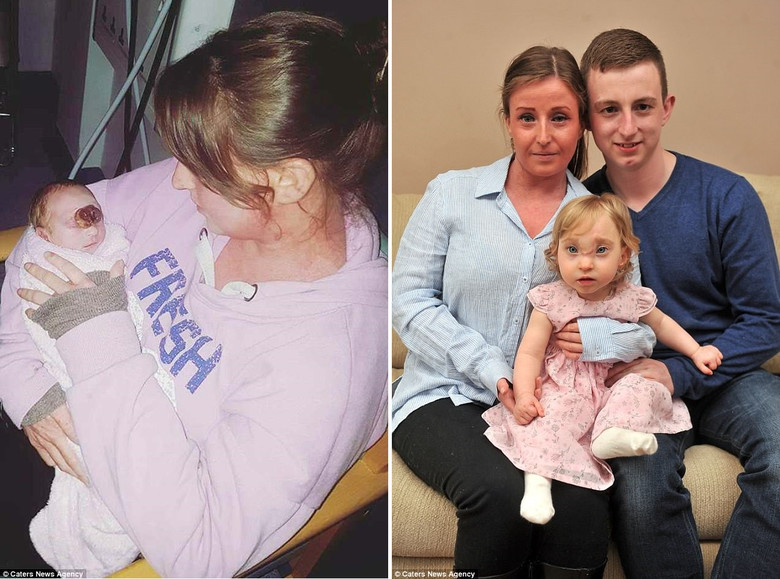
Each of these anomalies, even individually, is considered life-threatening, but together they simply left the child with no chance. The most dangerous was considered to be an encephalocele—part of Carly’s brain was located outside the body, right on the bridge of her nose.

After Carly miraculously survived the first day, doctors were still sure she would die within a few days, and the child was not even treated; they simply discharged her home with her mother so that the girl could end her suffering peacefully with her family.
But Carly stubbornly refused to die, and a month later, her parents, Gemma McCusker and Kyle Tolland, brought the baby to a Belfast clinic for surgery. During the procedure, surgeons carefully removed the outer portion of the baby’s brain. Carly made a rapid recovery after the operation.
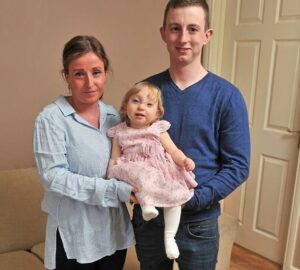
Despite her multiple anomalies, the girl has learned to crawl and eat with a spoon. Overall, she’s showing very good development for her condition. Her parents are confident that their child will soon begin walking.
“She smiles and can laugh when she’s in a good mood. When I look at her, I’m proud of my daughter,” says Gemma McCusker. “She’s a little miracle. I don’t know how long she’ll live, but we’re confident she’ll defy even the most dire predictions about her condition for a long time to come.”
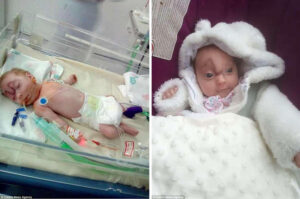
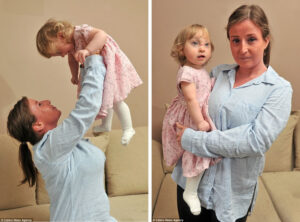
Carly truly doesn’t look like a child with serious brain problems. Even in photographs, it’s clear she’s far from a “vegetable.”
“After she was discharged from the hospital, our main goal was to care for the exposed brain tissue on her forehead to prevent infection. We carefully cleaned it with sterile water and regularly wiped away the oozing brain fluid.”
During her pregnancy, Gemma McCusker was told her daughter would likely have some head abnormalities. Gemma assumed it was a missing ear, an eye, or something about the nose, but no one expected part of the baby’s brain to be protruding.