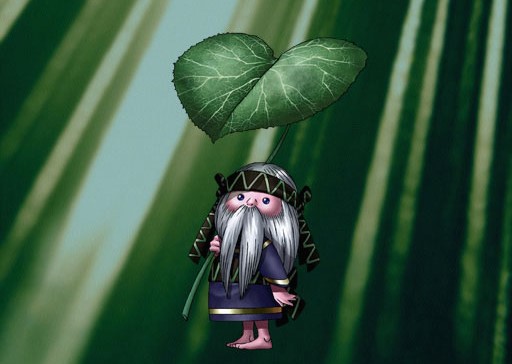
These people are sometimes also called by the terms Koro Pokunguru or Tsuchigumo, and the most common name, Koropokkuru, is translated as “people who live under the burdock leaf” and directly refers to the very small stature of these creatures.
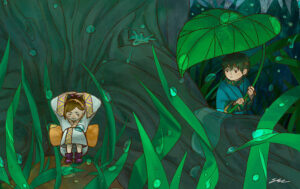
In Japan, a very popular image of Koropokkuru is a man holding a burdock leaf in his hand and using it as an umbrella to protect himself from the rain.
Sometimes legends tell of creatures so small that an entire family could fit under a single burdock leaf. There are also stories of Koropokkuru reaching a height comparable to that of human children, about 60-80 cm.
But regardless of the different places where stories about these little people circulate, special emphasis is always placed on their extremely small stature. And perhaps this trait is the only truthful detail remaining in these legends about the existence of this mysterious tribe.
In addition to their small stature, the Koropokkuru are often said to have been a rather primitive and crude people, with very large heads, a large, flattened nose, and bushy eyebrows. Reddish skin is sometimes mentioned, but they are often said to have been very hairy and quite smelly.
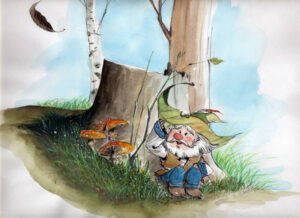
Interestingly, the Japanese often described the Ainu themselves in early centuries as “hairy, smelly, brutes, like animals.” However, there are indications that the Koropokkuru were much closer to humans than to animals. It is mentioned that they used stone tools and were skilled in making beautiful pottery. However, the Ainu did not make pottery at all.
According to Ainu legends, the tiny people were wary of humans and always tried to hide from them in the forest. Nevertheless, they occasionally engaged in barter trade with the Ainu, always at night. And for many centuries, the Ainu and Koropokkuru coexisted peacefully, until one day a brutal war broke out between them, and almost all of the Koropokkuru were exterminated, and the survivors were driven into exile.
It’s extremely difficult to find anything substantial in these legends, much less actual evidence of the existence of these people. However, archaeologists do have some clues. For example, strange dugouts have been found in Ainu settlement sites, completely unlike the traditional thatched houses of the Ainu.
Stone tools were also found that were too small to be used by a person of normal size.
Another mystery was posed by archaeologist Edward Morse, who in 1877 was one of the first to conduct archaeological excavations in Japan. He discovered numerous ancient potsherds at the Omori shell site that were completely inconsistent with Ainu culture. In his work published in 1879, Morse wrote that the potsherds belonged to an unknown Neolithic culture that existed before the Ainu arrived in Hokkaido.
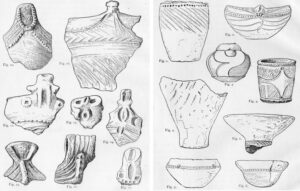
Morse’s work was continued by his student Tsuboi Shogogo, and it was he who suggested that the tiny tools, small dugouts, and pottery shards were the work of the same tribe, and that this tribe was the legendary Koropokkuru.
Nowadays, some researchers of Hokkaido culture also adhere to this version and believe that the tiny people could have been descendants of short “hobbits” from the Indonesian island of Flores.