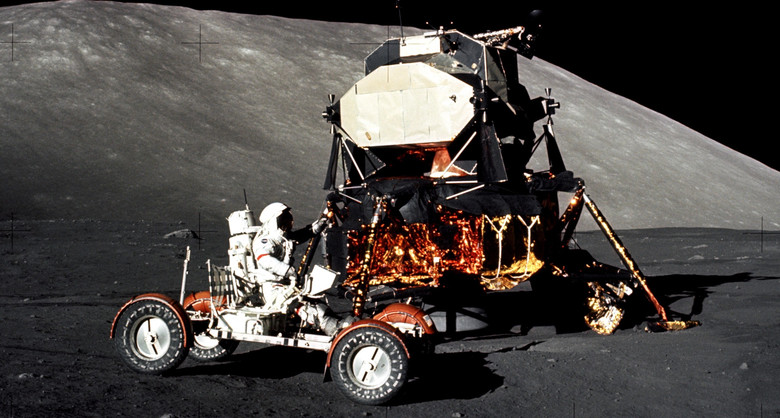
In 1996, the book “Lost Space” was published by one of the Apollo project participants, a certain Dr. Edwin Rice, in which Rice claimed that during the Apollo 17 expedition, the astronauts allegedly encountered unknown inhabitants of the Moon who spoke to them in Latin!
While traveling on the lunar surface in the Rover, the astronauts allegedly encountered a small dome-shaped structure from which about a dozen crustacean creatures suddenly poured out. The creatures did not attempt to attack the rover, but the Rover ceased to obey the astronauts. The situation was becoming tense.
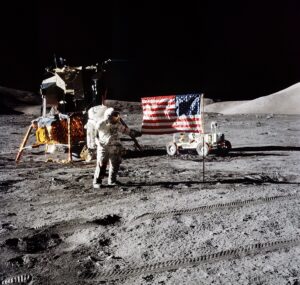
Apollo 17
And at that time, on the short-range radio, they heard clear, sonorous speech in a language that turned out to be Latin, which was transmitted to Houston, where it was translated – the astronauts themselves, naturally, did not speak Latin to a level sufficient for dialogue.
The astronauts were told they had trespassed on alien territory and should now leave. The lunar inhabitants, the Selenites, rejected attempts at negotiation and merely repeated their offer. After this, control of the Rover was restored, and the astronauts hurried to the lunar module.
The existence of Selenites on the Moon was immediately declared a state secret in the United States. It was believed that the dissemination of this information could lead to unpredictable consequences, including the collapse of the state apparatus. News of a super-civilization located very close by could cause panic, fear, and, in any case, an inferiority complex.
Apollo 17’s return to Earth was successful, but the question arose: what to do next? Who, exactly, had they encountered on the Moon—true Selenites, aliens from other worlds, or perhaps Russians? The latter initially seemed most likely: the Russians had allegedly established a secret colony on the Moon. However, analysis of the Selenite message revealed it was not delivered with a human larynx. A machine sound?
The Lunar Scout reconnaissance vehicle was urgently prepared and secretly launched to the Moon in the spring of 1973. The station’s descent module landed near the Apollo 17 landing site. The Scout headed toward the known location, and its orbital module entered a high selenocentric orbit and began observing the planet’s surface using equipment used for reconnaissance above Earth.
The Scout never reached its destination—communication with it was lost en route. The orbiter transmitted a coded signal to Earth: “Landing on the Moon is prohibited. Proof of force will follow at 15:00 GMT,” followed by the coordinates of a national park.
At the appointed time, they expected anything—a fire, an explosion, a storm. But something completely different happened. Over an area of four hectares, all the trees lost first small branches, then large ones, until only bare trunks remained.

Experts concluded they had witnessed the use of a gravity weapon. They were forced to acknowledge the extraterrestrial origins of the Selenite civilization. They also concluded that this civilization could pose an undeniable threat to Earth.
Analysts from various agencies began developing scenarios for interplanetary conflict—and everyone agreed that conflict should be avoided at all costs. The Selenites’ behavior suggests they are a closed civilization, unwilling to establish contact and prepared to defend their territory. The extent of their development is unknown, but the capabilities demonstrated by the Selenites necessitate extreme caution. Above all, no provocative moves.
And the Americans left the Moon.
However, a pretext was needed to curtail the lunar programs, and one was quickly found: the Moon was of no interest, and there was no point in spending taxpayers’ money on it.
At the same time, contacts were made with the Russians. It turned out that they, too, were faced with the Selenite problem.
The Apollo-Soyuz experimental flight, carried out in the summer of 1975, also had political significance—the two space powers demonstrated that they were ready for unity in the face of a possible external threat.
Edwin Rice had a reputation for being serious and not prone to mystification. Indirect confirmation of his claims is the fact that both the US and the USSR effectively abandoned their lunar programs in the mid-1970s.
Modern technological and economic developments allow us to set goals incomparably greater than simply exploring the lunar surface. Colonizing the Moon is a goal worthy of the 21st century. Yet the US government, which has spent tens and tens of billions of dollars on the Iraqi campaign without blinking an eye, is strangely stingy when it comes to resuming lunar expeditions.
This oddity becomes entirely explainable if both the testimonies of compatriots involved in the lunar programs and Rice’s work are considered reliable and true.
Who are the Selenites? Why do they communicate in a dead Latin language—out of political correctness, so as not to show favoritism to any of the currently existing countries? Or did they have past contact with the Roman Empire and, therefore, are capable of landing on Earth?
Or is it that Roman, and before that, ancient Greek mythology is based on real events, and the ancient divine pantheon is a super-civilization described by the ancient mind?
Or are their agents among us even now?
And then two questions arise.
First: isn’t modern Earth civilization essentially a carefree one? We announce ourselves loudly to the entire universe: every day, thousands upon thousands of transmitters broadcast information about our civilization in all directions, including into space. Sooner or later, this information may reach predatory civilizations. Are we prepared for their arrival?
Second: if the Selenites exist, doesn’t that mean the other planets are also occupied by inhabitants who jealously guard their territory? Likely, they, like the Selenites, don’t constantly control every meter of their planets’ surfaces—just as we don’t control Earth. But when a spacecraft enters a populated area, it could be subject to attack.
From the book by V. Azhazha, “Caution: Flying Saucers!”